When a torque limiter torque limiter trips the first time you power up a machine, the natural assumption is that something is wrong with the limiter. In this case, the limiter was doing exactly what it was designed to do. The real culprit was how the motor was being started.
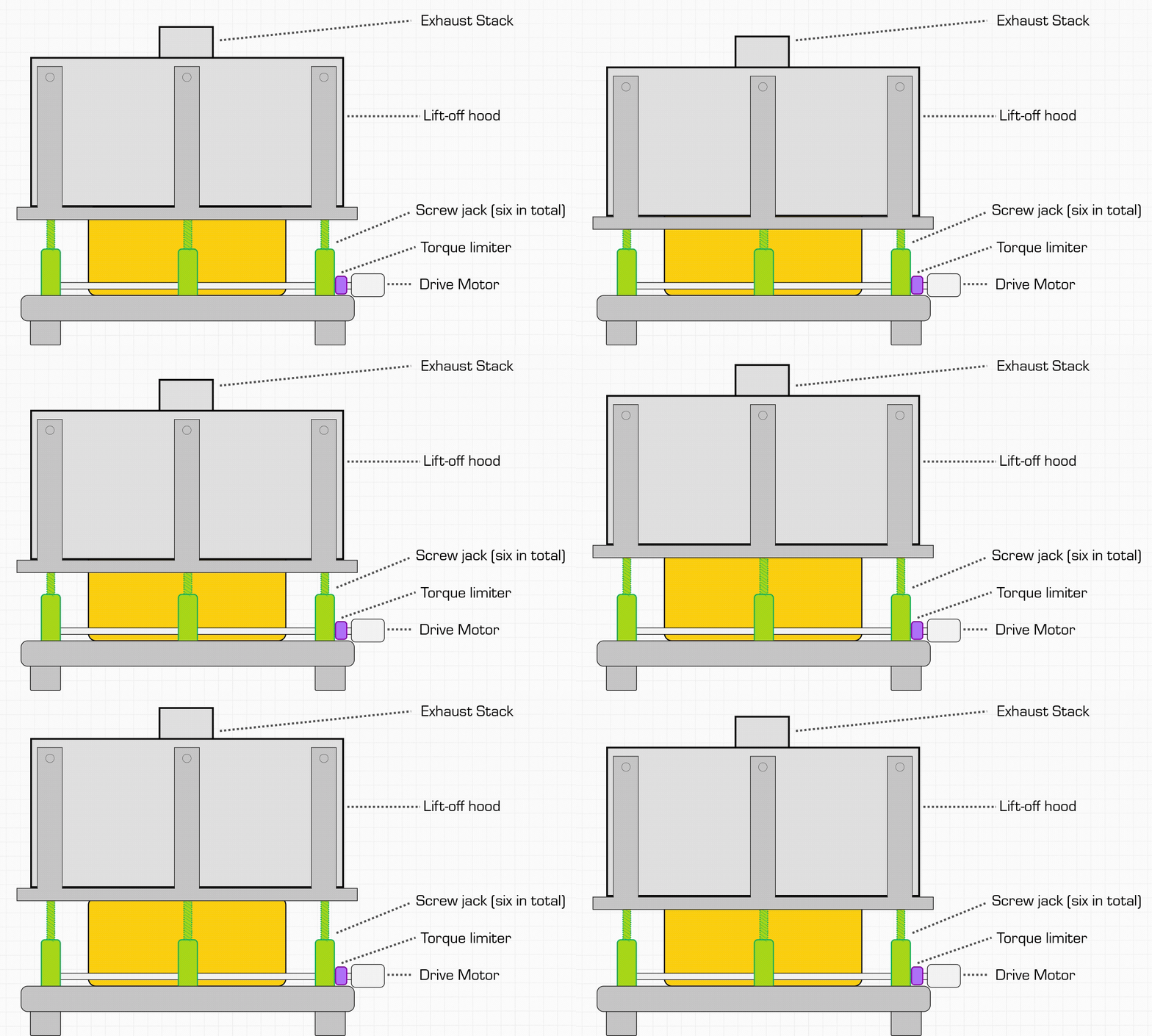
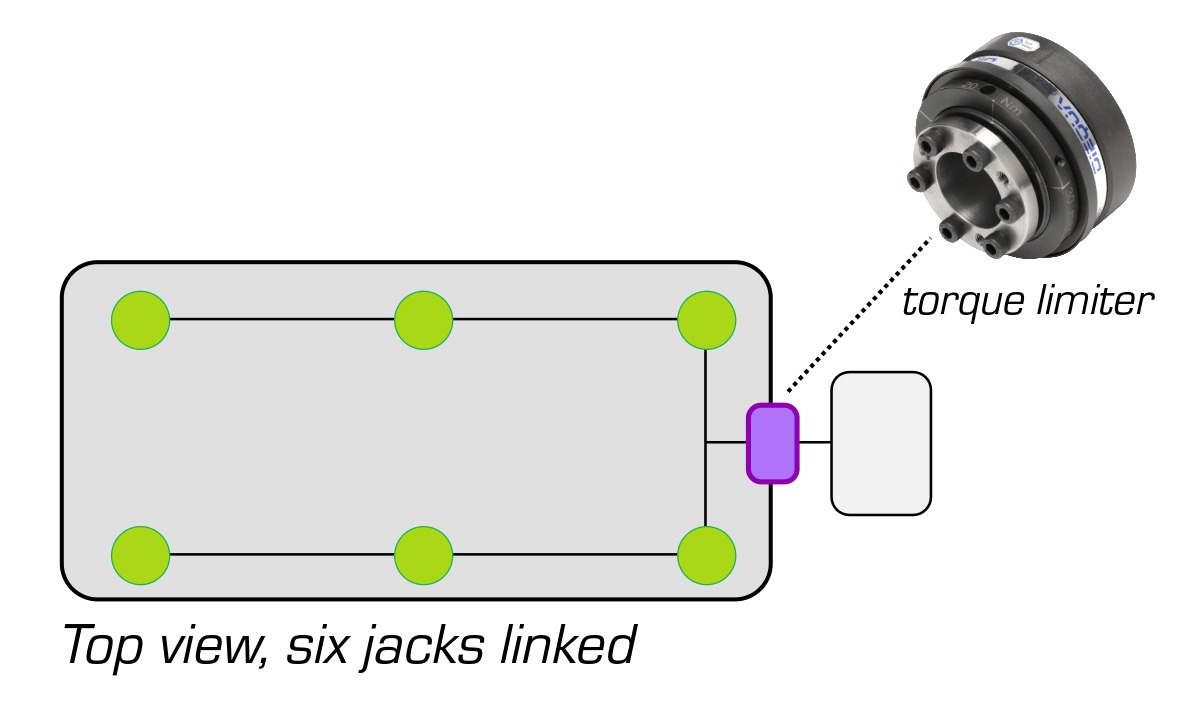
We worked with a client to provide the components for a six-jack screw jack system to lift the heavy hood of an industrial oven, with a mechanical torque limiter at the motor to protect against a jammed jack. On the first factory test, it tripped immediately. Here’s why a protective device earns its place to prevent both potential injuries and downtime.
The Application: Industrial Oven Hood Lift
A customer required a complete screw jack lifting system to elevate a heavy hood of an industrial oven for monthly maintenance and cleaning cycles. The specifications included:
- Drive Configuration: A single high-torque motor driving a multi-axis layout.
- Load Distribution: Synchronized lifting across six distinct jack positions
- Risk Factor: Due to low operating duty cycles and the potential for mechanical binding, engineers identified a severe risk: if a single jack jammed, total motor power would concentrate at a single failure point.
Engineering the Drivetrain Layout
Placing a torque limiter close to the load is standard practice, but in a multi-jack layout it introduced secondary risks. If a remote limiter tripped while others continued driving, severe structural twisting, shaft bending, and mechanical binding would ensure.
To mitigate this, a mechanical torque limiter was integrated directly at the motor output to instantly sense overloads and decouple the drivetrain, disengaging all jacks simultaneously.
Gearbox ratios, line-shaft torsional rigidity, intermediate couplings, and system efficiencies were meticulously calculated to determine precise motor sizing:
- Centralized Disengagement: The limiter was coupled directly to the primary motor shaft, ensuring the entire system disengaged simultaneously under an overload event.
- Component Up-rating: Individual jacks were sized one step larger so their rated capacity exceeded the cumulative torque required, with a comfortable safety margin.
Factory Test: The Unexpected Trip
During initial factory commissioning, the system was powered on and the torque limiter immediately tripped. After re-verifying the shaft and jack alignment and double-checking mathematical load calculations, a second test was executed. The result? Another fault trip identical to the first.
Suspecting a premature release or miscalibration, the team temporarily replaced the limiter with a standard shaft coupling (under controlled, supervised conditions) so testing could continue. With the limiter bypassed, the motor engaged and, after a heavy initial groan, the hood began to rise.
Root Cause Analysis: Inertia vs. Instantaneous Torque
The removed torque limiter was brought back to our facility for bench testing, where it functioned perfectly within its rated parameters. To uncover the root cause, an integrated high-resolution amp-draw monitoring equipment was installed.
The data revealed the culprit: the client’s original sizing calculations accounted for running torque but not the starting torque of an across-the-line start. It’s an easy item to miss, and a good reason to check starting torque early in any limiter application.
Here’s what caused the torque limiter to trip at startup:
- Inrush and Acceleration Spikes: Because power was pulled directly from the main utility line, the motor attempted to instantaneously accelerate the massive rotational inertia of the entire multi-axis drive train while simultaneously overcoming static friction.
- Mechanical vs. Electronic Response: This generated a massive initial current rush and a transient peak torque spike that far exceeded normal running loads. While programmable electronic drives can be configured with ramp-up delays, mechanical torque limiters are engineered to be high-speed, deterministic safety devices that disengage instantly upon reaching their threshold.
Peak starting torque can often be 2x to 3x higher than running torque, which explains why the safety threshold was tripped at the onset.
The Solution: Optimized Acceleration Control
The fix was straightforward: integrating an electronic soft start (or VFD acceleration ramp) to control motor starting current and smooth out initial rotational acceleration. This controlled ramp-up kept starting torque safely below the disengagement threshold, allowing the mechanical torque limiter to remain armed while the entire motion system operated flawlessly. Raising the trip setting wasn’t a good option, since it would have weakened protection against a real jam. Limiting starting torque at the source kept both the protection and the smooth start.
Partner with DieQua’s Engineering Team
A torque limiter is a good investment when a single jammed jack could mean replacing jacks, line shafts, and couplings, and lost days of production. In this project, the limiter proved its value twice: it exposed a starting-torque issue during testing, and it remained in place to protect the system afterward.
Contact our engineering team today to discuss your next motion control application. We’re happy to help you in the same way we helped the client in this case study.