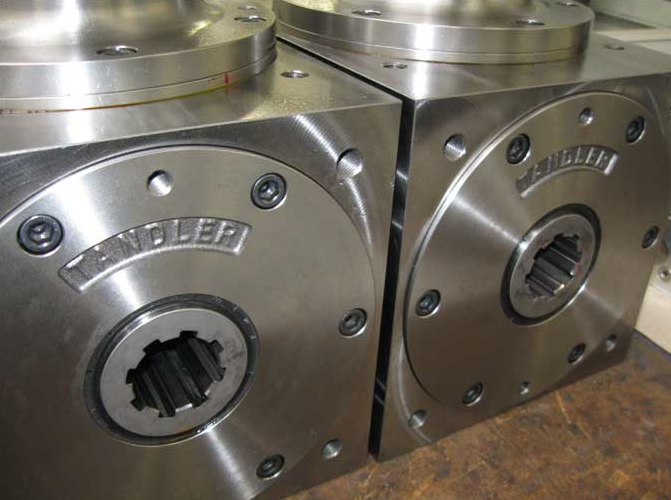
Why we chose spline shafts over keyed shafts:
We guided the client to use spline shafting and a hollow shaft gearbox with a mating profile. Spline shafts have a looser tolerance than standard keyed shafts, which reduces the possibility of binding and fretting the key during adjustment from misalignment.
When designing machinery with multiple rotating components, maintaining precise rotational timing is critical—especially when one of those components must physically move during operation. Common applications that require synchronized, adjustable motion include:
- Coating lines requiring precise applicator gap control
- Packaging lines adapting to varying package heights
- Roll formers & die cutters adjusting for material thickness differences
- Processing equipment needing quick retraction for cleanup or set-up
Here is a breakdown of a real-world application challenge and the specialized gearbox configuration we suggested to solve it.
The Application Challenge
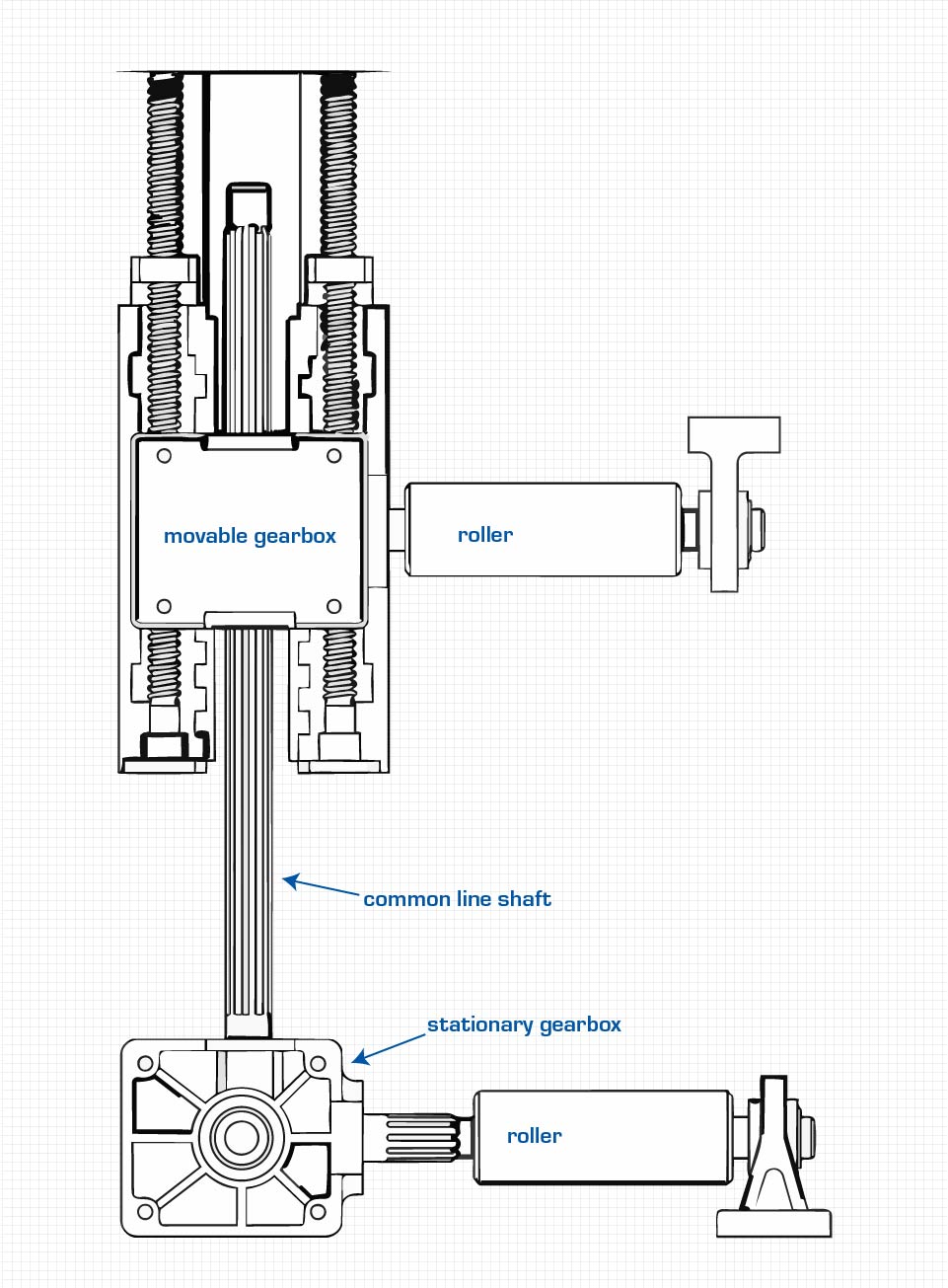
A customer needed to drive two parallel rollers using a single drive motor.
- Roller 1 (Lower): Stationary position.
- Roller 2 (Upper): Required incremental vertical adjustment for gap control, as well as a larger travel range for tooling changes and setup.
The Initial Concept:
The original design called for two right-angle gearboxes mounted on a common line shaft. The moveable gearbox would sit on a vertical carriage guided by a dovetail slide and adjusted via a ball screw. To transmit torque, the customer planned to slide a long-keyed shaft through a standard hollow-shaft gearbox.
The Problem:
Keyed shafts require extremely tight tolerances to avoid backlash and clearance issues. When sliding a shaft through a keyed bore across multiple independent frames (main frame, moving carriage, and guide rails), even minor manufacturing or mounting misalignments will cause the assembly to bind and shear the key.
The Solution: Mating Spline Shafts with Hollow-Bore Gearboxes
Instead of a traditional keyed shaft, the optimal approach is using a spline shaft paired with a matching spline-bore hollow shaft gearbox.
Why Splines Work Better:
-
Reduced Binding Risk: Spline profiles distribute torque across multiple teeth and accommodate slightly looser sliding tolerances, allowing smooth axial travel without binding.
-
High Torque Transmission: Despite allowing lateral movement, splines offer superior rotational rigidity and torque capacity compared to a single keyway.
Key Assembly & Alignment Best Practices
Implementing a sliding spline line shaft successfully requires careful attention to system setup and alignment:
-
Fixed-End Anchor:
The drive end of the spline shaft is turned and keyed, locking firmly into the stationary bevel gearbox hollow shaft with a draw-in bolt. -
Floating-End Support:
The opposite end extends through a self-aligning bearing before connecting to the motor via a flexible coupling. The self-aligning bearing absorbs minor mounting variations. -
Case Hardening:
Because a sliding spline shaft continuously transmits torque while moving axially, it is subject to high contact stress and friction. Utilizing a case-hardened spline shafts and bores provides a crucial advantage. Case-hardened components are more wear resistance and last longer. -
Carriage & Rail Alignment:
The moveable carriage must be precisely parallel with the dovetail guide rails. Shimming the gearbox mounting surfaces ensures the internal hollow bore stays completely parallel to the travel axis. -
Travel Testing:
Before final torque is applied to the self-aligning bearing, run the carriage through its full stroke. If the spline shaft moves smoothly without end play or resistance, alignment is verified.
Why Single-Source Manufacturing Matters
Even high quality machine builders will have difficulty building a gearbox to match and existing spline shaft. Tolerance ranges, variations in tooth profile geometry, pressure angle, and a different manufacturing technique or environment can lead to subtle fit issues, premature wear, and backlash.
Sourcing both the spline shaft and the hollow-bore gearboxes from the same manufacturer ensures a perfect, precision-engineered fit. Single-source manufacturing guarantees that the male and female spline profiles are cut and finished to complement each other exactly, eliminating assembly frustration and maximizing power transmission efficiency.
Partner with Motion Control Specialists
While sliding spline shaft configurations require up-front planning for frame tolerances and alignment, they are a proven, highly effective solution for variable-center distance applications. At DieQua, we offer custom shaft profiles, including specialized spline bores, as standard options across our right-angle spiral bevel gearbox lines.
Have a complex motion synchronization challenge? Contact our gearbox consultants today to optimize your next machinery design.