It’s 2 a.m. on a packaging line. A gear motor faults, and the maintenance technician traces it to a failed winding. The gearbox is fine. It still has years of service life left, the lubricant is clean, and the gearing is tight.
But the motor and gearbox are one integral unit. The motor’s rotor shaft doubles as the gearbox’s input pinion and the housing is a single proprietary casting. The fix is a full replacement: a new gearmotor unit, a new lead time, a new invoice for a gearbox that didn’t fail.
This is the hidden cost of integral gearmotors. They’re a popular option for large manufacturers for good reason: they’re compact, convenient, and often cost-effective for high volume OEMs. But the end-users who live with that design for the next 15 to 20 years are the technicians on the plant floor who service it.
The OEM Saves Once. The End User Pays Repeatedly.
Integral designs optimize the build, not the service life. This results in…
- Wasted gearbox life. A motor failure retires a perfectly good gearbox. You pay for mechanical life you never got to fully use.
- Longer downtime. Replacing a whole gearmotor means waiting on a single manufacturer’s lead time, when a standalone motor is often available faster from multiple sources.
- Single-source dependence. You can’t substitute a competitor’s motor. If the original supplier is backlogged, your line waits, and replacement surcharges build.
The same lock-in hits the OEM when the customer changes their factory servo standard mid-product, or when a supply chain disruption makes a preferred motor brand unavailable for months.
Try This Instead: Decouple the Motor from the Gearbox
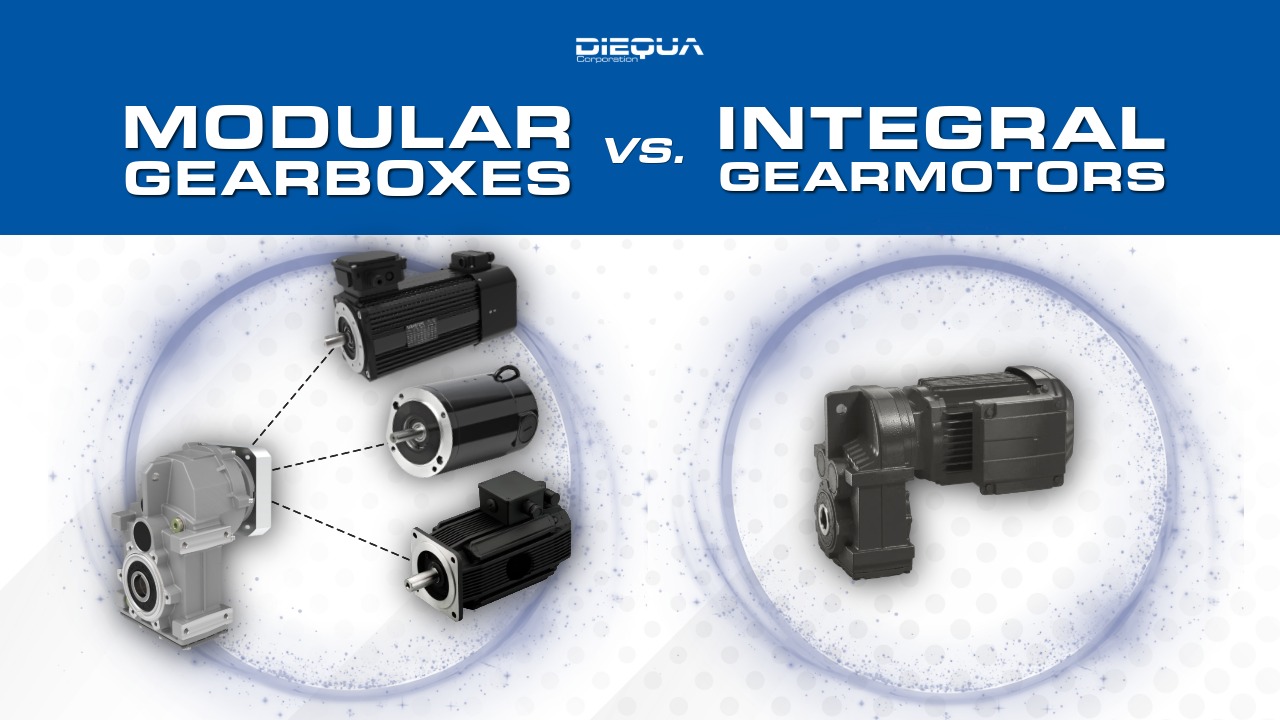
We believe a gearbox should adapt to your design, including your preferred motor, not the other way around. Our gearbox designs separate motor mounting interface from the gearbox casing, so the motor becomes a serviceable, swappable component rather than a permanent part of the housing.
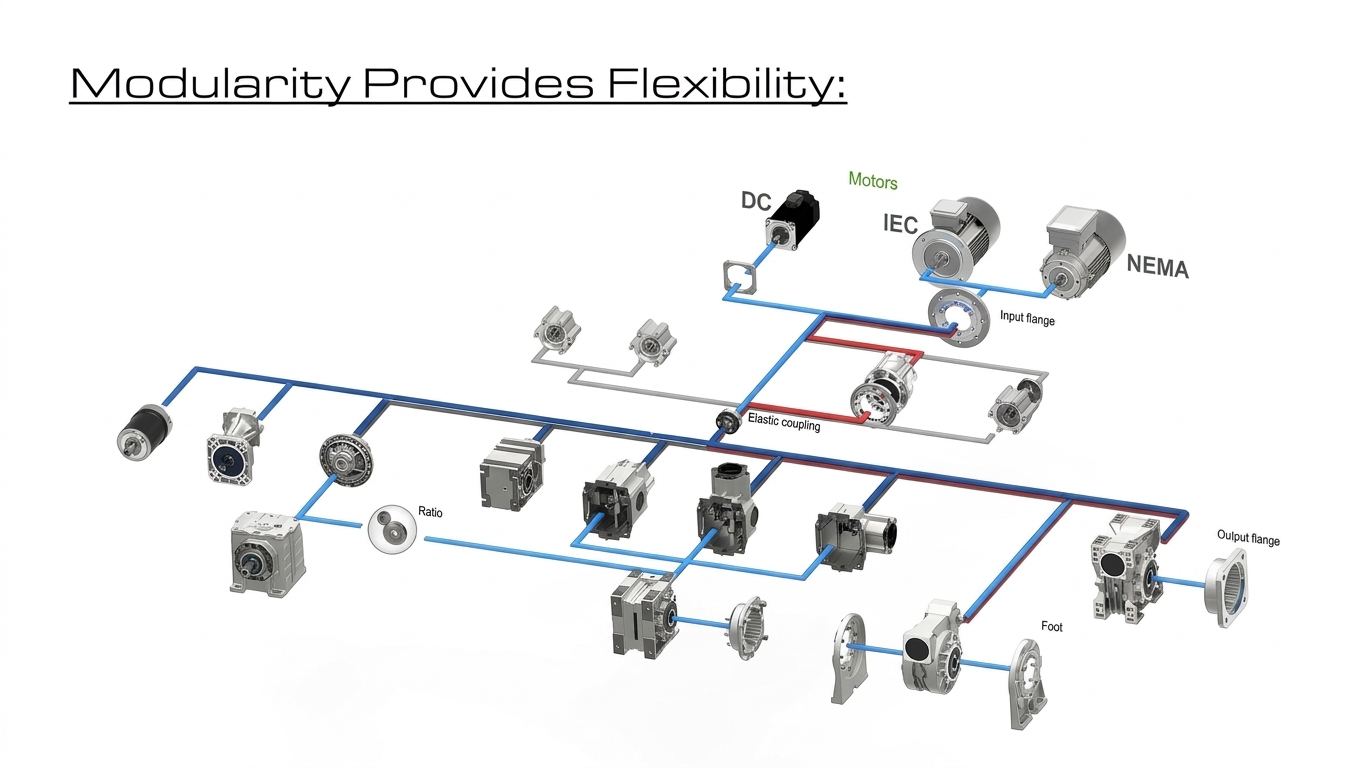
DieQua’s modular gearbox series—such as GearSync and DSW—utilize innovative coupling and cover-kit systems designed to decouple the motor from the housing.
Rather than relying on traditional, permanent metal-on-metal designs that lock a specific motor to a proprietary casing, a single gearbox can be easily adapted to a vast array of standard and specialized motor types and sizes.
Our versatile mounting designs seamlessly integrate with multiple frame sizes including standard IEC and NEMA electric motors, high-performance brushless motors, or specialized AC, DC, and servo drives.
| Modular Gearbox | Integral Gearmotor | |
|---|---|---|
| Design | Built from separate, standardized modular components (input flanges, gear stages, output shafts, etc.) that can be mixed and matched. | Motor and gear train are engineered together as a single unit; typically sharing common shaft and housing |
| Motor Connection | Universal adaptors or motor flanges; configurable mounting positions allow motors to be swapped out | The motor is permanently built-in; cannot be easily swapped for a different brand or frame size |
| Flexibility & Repair | High flexibility to change ratios, reconfigure mounting positions, or replace individual damaged parts without scrapping the whole unit | Low modularity; if the motor burns out or the gear set fails, the entire unit likely needs replacement |
| Assembly & Lead Times | Easier to stock parts, faster time-to-market; more custom configurations | Locked into a single manufacturer; fixed configurations; whole unit assembly in-factory |
| Best For: | High quality OEM machinery focused on easy maintenance; industrial automation; changing requirements; fast retrofits | High volume OEM machinery |
What Modularity Means for Technicians and End Users
- Replace only what failed. When a motor fails, swap the motor and keep the gearbox in service for its full design life.
- Faster recovery. Source a replacement motor from whichever vendor can deliver soonest, instead of waiting on a single manufacturer.
- Lower lifetime cost. Over the life of the machine, replacing motors instead of complete gearmotors adds up.
- Upgrade without design. Moving to a newer or higher-efficiency motor later doesn’t require re-engineering.
The next time you’re shopping for a new machine or having an OEM build a new one for you, ask for modular gearboxes.
What This Means for OEMs
Modularity also protects your design:
- Design once, deploy globally. One machine footprint serves customers who specify a German-controlled platform or an American servo brand. Only the bolt-on input flange changes.
- Mitigates supply chain risk. If your primary motor vendor has a backlog, validate and mount an alternative without reworking CAD models or changing your gearbox spec.
- Allows end-users to upgrade in the future. Using modular motors allows end users to upgrade from AC or NEMA motors to a Servo for more dynamic control.
Consider providing modular gearboxes in your designs to support your end users.
Choose the Motor for Performance, Not for Layout
Your motor should be selected for its torque, acceleration profile, feedback resolution, and control architecture, not because it’s the only one that fits the housing. And when that motor eventually wears out, your customers shouldn’t have to scrap a healthy gearbox along with it.
Talk to a DieQua application engineer about modular gearbox options for your next design, or for a drop-in alternative to your current integrated gearmotors.